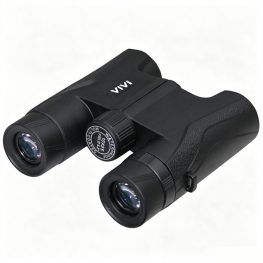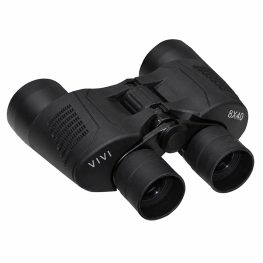


Description: In This Guide What a Prism Actually Does BAK4 (BaK-4) Glass: The Short Version BK7 (BK-7) Glass: The Short Version Key Differences at a Glance Total Internal Reflection (TIR) When...
What a Prism Actually Does
Objective lenses gather light and form an image upside-down. A prism is the optical element that flips (or erects) that image right-side-up for your eyes, while also folding the light path so the device stays compact. Nearly every binocular and spotting scope on the market uses either a Porro-prism or a roof-prism layout—and those prisms are cut from one of two glass types: BaK-4 or BK-7.
The refractive index and dispersion of that glass directly affect how light bounces through the prism to your eyepiece. Get the glass wrong, and you lose brightness, edge sharpness and image shape.
BAK4 (BaK-4) Glass: The Short Version
“BaK-4” is the Schott Glass designation for a dense barium-crown optical glass with a refractive index of approximately 1.569 (d-line). Its higher refractive index means:
- Light reflects efficiently inside the prism at steeper angles.
- The exit pupil stays perfectly round, preserving maximum light to your retina.
- Less light is “strayed” into the corners, so edge-to-edge clarity is better.
- Total internal reflection (TIR) can be relied on in Porro designs, eliminating the need for reflective coatings on every surface.
In short, BaK-4 lets designers build brighter, sharper prisms that are more forgiving of angle-of-incidence variations.
BK7 (BK-7) Glass: The Short Version
“BK-7” is a conventional borosilicate crown glass (Schott designation), with a lower refractive index around 1.516. Because the index is lower:
- The critical angle for total internal reflection is wider—so light at the edges of the beam hits the glass-air interface below that angle and leaks out instead of reflecting.
- The exit pupil becomes squared-off or “cat’s eye” shaped with dim corners.
- Overall throughput is lower (visible in twilight or heavy-contrast scenes).
- To compensate, all reflective surfaces must receive metallic coatings (aluminum or silver), which add cost and can degrade over time.
BK-7 prisms are cheaper to manufacture and perfectly adequate for entry-level optics, casual use and short-distance observation where corner illumination is less critical.
Key Differences at a Glance
| Parameter | BaK-4 | BK-7 |
|---|---|---|
| Refractive index (nd) | ~1.569 | ~1.516 |
| Critical angle (glass→air) | ~39.3° | ~41.2° |
| Exit pupil shape | Round | Square / clipped corners |
| Practical light transmission* | ~85–90% (with FMC) | ~75–82% |
| TIR reliance | Yes (Porro); reduces coating need | No; must coat all surfaces |
| Edge sharpness | Better | Softer corners |
| Twilight factor advantage | Higher effective brightness | Noticeable loss at low light |
| Cost | Higher (barium glass) | Lower |
| Typical use | Mid-range → premium optics | Budget / entry-level optics |
*Assumes comparable multi-coating quality in both designs.
Total Internal Reflection (TIR) and Why It Matters
In a classic Porro prism, light strikes the hypotenuse face at ~45°. For TIR to occur, the angle must exceed the critical angle of the glass (the angle beyond which all light reflects instead of passing through).
With BaK-4’s higher refractive index, the critical angle drops to ~39°. The 45° bounce clears that threshold easily, so the prism acts as its own mirror without metallic coating. The result is a brighter image with no coating degradation.
Switch to BK-7 and the critical angle rises to ~41°, and light hitting the corners at slightly lower angles is partially transmitted through the glass and lost. The fix is to coat those surfaces with reflective metal, which adds absorption loss (typically 5–15% per surface) and long-term aging.
When Prism Type Really Matters
Not every observation scenario punishes a BK-7 prism equally. Here’s where it counts and where it’s less critical:
High impact—choose BaK-4
- Birding at dawn / dusk (low-light; low-light binoculars rely on every photon).
- Astronomy and wide-field stargazing (you’re already working near the eye’s threshold).
- Digiscoping / wildlife photography with a spotting scope—square exit pupils cast vignetted corners on a sensor.
- Long-range target identification—edge sharpness at high zoom (12×, 16×, 20×) separates “is that a deer?” from “I can count the antler points.”
Lower impact—BK-7 may suffice
- Daytime casual use (concerts, boat tours, backyard bird feeders).
- Short-distance viewing at 7×–8× magnification where exit pupil is oversized anyway.
- Budget products under ~$50 where coating quality and ED glass would matter more than prism type alone.
Common Myths
- “If it says BaK-4 in the listing, the whole prism path is BaK-4.” Not always. Some budget optics use a BaK-4 front element with BK-7 rear elements, which partially defeats the purpose. Check brand reputation and reviews, or do the cat’s-eye test.
- “Coatings make the glass irrelevant.” Multi-coatings improve throughput but cannot fix a misshapen exit pupil caused by TIR failure. The geometric loss at the edges is not coating-dependent.
- “Roof prisms don’t use BaK-4 vs BK-7 distinction.” The Schrott phase-coating layer on roof prisms demands a high-quality glass substrate. Virtually all decent roof-prism binoculars use BaK-4; if they don’t, that’s a red flag.
Verdict & Buying Advice
If you are buying any optic for regular outdoor use—hunting, birding, glassing, astronomy—specify BaK-4 prisms with fully multi-coated (FMC) optics. The real-world brightness gain and round exit pupil are not marketing tricks; they show up in your eyes within seconds of comparison.
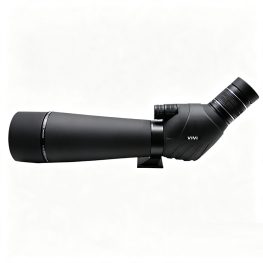
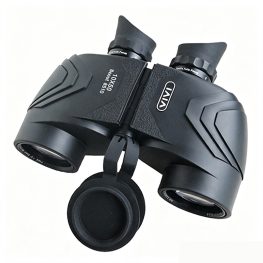
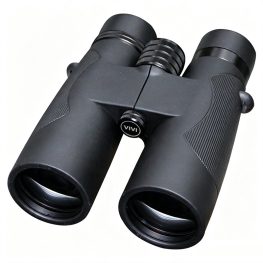
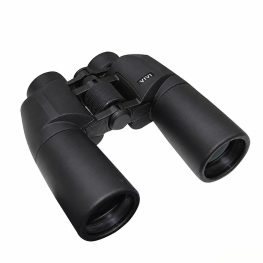
VIVI’s ED Binoculars and Falcon Series use BaK-4 prisms with phase-corrected coatings and FMC optics, so you get the full light-transmission benefit of barium glass paired with ED objectives.
For a first pair or short-range daylight use, a well-coated BK-7 Porro can be a perfectly capable starter. Just know what you’re trading and buy with eyes open.
Frequently Asked Questions
Is BaK-4 always better than BK-7?
For optical performance—yes, by design. BaK-4’s higher refractive index delivers rounder exit pupils and better edge-to-edge clarity. BK-7 is not inherently “bad,” just limited by physics. A premium BK-7 with high-grade coatings can outperform a poorly built BaK-4 with sloppy alignment.
How can I tell BAK4 from BK7 without specs?
Hold the binocular up to a light source and observe the exit pupil. Perfect circle = BaK-4. Clipped/square corners = BK-7. On a roof-prism design, you can’t see this as easily; rely on reputable brands, detailed specs or a hands-on comparison.
Does BAK4 mean ED glass?
No. BaK-4 is the prism material; ED (Extra-low Dispersion) refers to the objective lens glass. A binocular can be BaK-4 without ED, or (rarely) ED objectives with a BK-7 prism. For best overall performance, look for BaK-4 prism and ED or HD objectives with FMC coatings. All VIVI ED Binoculars meet both criteria.
Is phase coating more important than prism glass?
They address different problems. Phase coating corrects the polarization split unique to roof prisms and can improve contrast 5–15%. The BaK-4 substrate still determines the shape of the exit pupil and how much light makes it through. Both matter; you want them together.
Do spotting scopes also use BAK4 vs BK7?
Yes. Whether Porro or roof design, a spotting scope prism is either BaK-4 or BK-7. At the magnifications typical for high-power spotting scopes (30×–60×), any exit-pupil clipping from a BK-7 is very visible, so virtually all quality scopes above entry-level use BaK-4.
For questions about specific VIVI optics, reach out via our contact page or check the spec sheet on each product listing.