

Description: When comparing binoculars, 8×42 and 10×42 are two of the most common configurations you will encounter. Both use 42mm objective lenses, but they have different magnification levels. An 8×42 binocular...
When comparing binoculars, 8×42 and 10×42 are two of the most common configurations you will encounter.
Both use 42mm objective lenses, but they have different magnification levels. An 8×42 binocular provides 8x magnification, while a 10×42 binocular provides 10x magnification.
So, which one should you choose?
The answer depends on how you use your binoculars. 8×42 binoculars generally emphasize a wider, steadier and more relaxed viewing experience, while 10×42 binoculars provide greater magnification for observing distant subjects.
Understanding the differences in magnification, field of view, stability, detail, and portability can help you select the configuration that matches your needs.
8×42 vs 10×42: At a Glance
| Feature | 8×42 Binoculars | 10×42 Binoculars |
|---|---|---|
| Magnification | 8x | 10x |
| Objective lens | 42mm | 42mm |
| Relative image size | Lower | Higher |
| Field of view | Typically wider | Typically narrower |
| Handheld stability | Generally easier | More sensitive to movement |
| Distant detail | Good | More magnified |
| Portability | Similar class | Similar class |
| Common applications | Birding, hiking, travel, wildlife | Wildlife, birding, long-range observation |
The key difference is simple: 8×42 gives you a wider and easier-to-control view, while 10×42 gives you more magnification.
What Does 8×42 Mean?
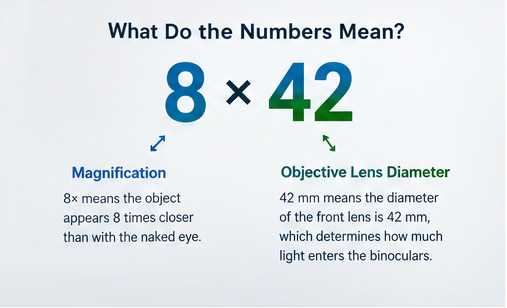
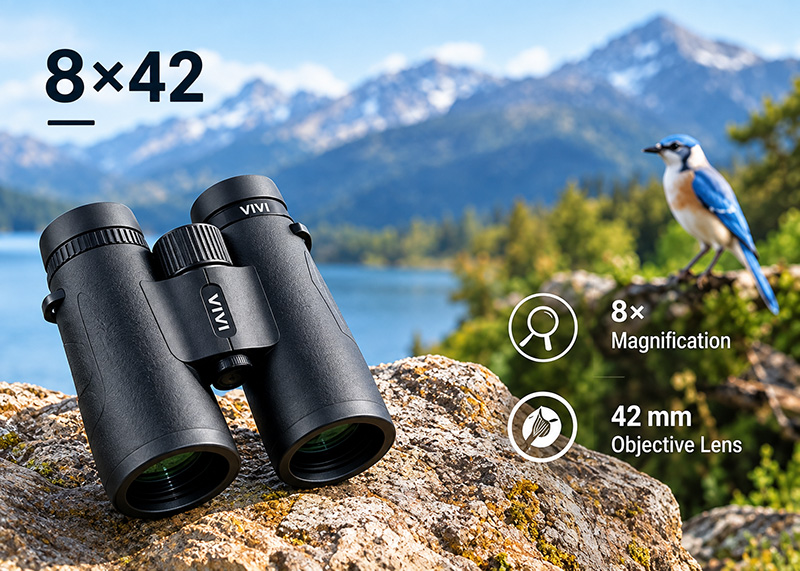
The “8” in 8×42 represents 8x magnification.
The “42” represents the 42mm diameter of the objective lenses.
With 8x magnification, an object appears approximately eight times closer compared with viewing it with the unaided eye.
Because the magnification is relatively moderate, 8×42 binoculars can be easier to hold steadily.
They are also commonly used when the observer needs to locate and track moving subjects.
What Does 10×42 Mean?
A 10×42 binocular uses the same 42mm objective lens diameter but increases magnification to 10x.
This means distant subjects can appear larger through the binoculars.
The additional magnification can be useful when you want to examine details on subjects that are farther away.
However, higher magnification also makes hand movement more visible.
For users who have difficulty holding binoculars steady, the difference between 8x and 10x can therefore be noticeable.
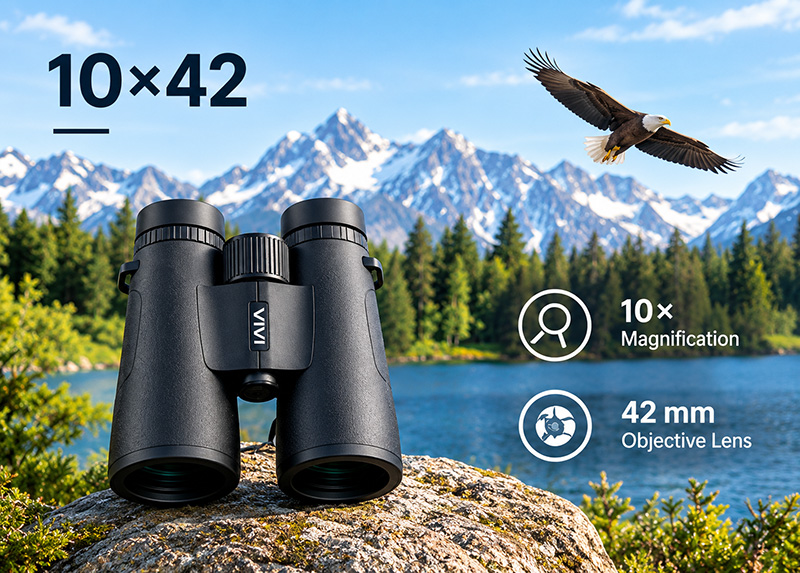
Field of View: 8×42 vs 10×42
Field of view is an important consideration when comparing 8×42 and 10×42 binoculars.
In general, 8x binoculars tend to provide a wider field of view than comparable 10x binoculars, although the actual field of view depends on the optical design of the specific model.
A wider field of view can make it easier to:
- Find birds quickly
- Follow moving wildlife
- Observe large landscapes
- Scan an area
- Track subjects in motion
This is one reason 8×42 binoculars are frequently considered a comfortable choice for bird watching and general outdoor observation.
Image Stability: Is 8x Easier to Hold Than 10x?
Generally, yes.
Higher magnification makes small movements of your hands more noticeable.
With 8x magnification, slight hand movement is less visually amplified than with 10x magnification.
This can make 8×42 binoculars easier to use for extended handheld observation.
For example, if you are walking through a forest and frequently raise your binoculars to identify birds, the relatively stable view of an 8x configuration can be convenient.
A 10×42 binocular can still be comfortably handheld, especially with good ergonomics and technique, but users may notice more image movement.
Which Is Better for Bird Watching?
Both configurations can work well for bird watching.
8×42 for Bird Watching
8×42 binoculars can be useful when:
- Birds are relatively close
- Birds are moving quickly
- You need a wider field of view
- You frequently scan large areas
- You prefer easier handheld viewing
The wider viewing experience can make it easier to locate a bird before focusing on specific details.
10×42 for Bird Watching
10×42 binoculars can be useful when:
- Birds are farther away
- You want more magnification
- You often observe across open areas
- You want to examine additional details
For example, when observing birds across a lake, open field, or distant tree line, the additional magnification of a 10×42 binocular can be helpful.
Which Is Better for Wildlife Observation?
The choice depends largely on viewing distance.
For woodland or close-range wildlife observation, 8×42 can provide a comfortable combination of field of view and stability.
For wildlife farther away in open terrain, 10×42 can provide more magnification.
If your typical environment changes between forests, fields, mountains, and open landscapes, consider which viewing condition you encounter most often.
8×42 vs 10×42 for Hiking
For hiking, both configurations can be practical.
Because both use 42mm objective lenses, their physical size and weight can be relatively similar depending on the optical and mechanical design.
The more important difference is how you prefer to view the landscape.
8×42 may be preferable if you want:
- Easy handheld viewing
- A wider field of view
- Easier subject tracking
- Comfortable extended observation
10×42 may be preferable if you want:
- More magnification
- More detail at distance
- Better visibility of distant subjects
For long hiking trips, weight, ergonomics, body design, and overall balance should also be considered rather than looking only at magnification.
8×42 vs 10×42 for Low-Light Viewing
Both configurations use 42mm objective lenses, so the objective diameter is the same.
However, their exit pupils are different.
8×42 Exit Pupil
42 ÷ 8 = 5.25mm
10×42 Exit Pupil
42 ÷ 10 = 4.2mm
The 8×42 configuration therefore has a larger exit pupil.
In lower-light conditions, this can contribute to a more comfortable viewing experience, assuming the observer’s eye can make use of the available light.
However, low-light performance depends on much more than exit pupil.
Optical transmission, lens coatings, glass quality, prism design, and overall optical construction also affect how much usable light reaches the eye.
For this reason, two binoculars with identical 8×42 specifications can still produce different viewing experiences.
8×42 vs 10×42 for Long-Range Observation
If your main goal is observing distant subjects, the additional magnification of a 10×42 binocular can be useful.
At 10x magnification, distant subjects appear larger compared with an 8x binocular.
This can make it easier to distinguish details when observing:
- Distant wildlife
- Birds across open terrain
- Mountain landscapes
- Sporting events
- Outdoor activities
However, more magnification does not automatically mean a better overall viewing experience.
If the subject is moving quickly or you need to scan a large area, the wider and steadier view of an 8×42 binocular may be more practical.
8×42 vs 10×42: Which Has a Wider Field of View?
In many comparable binocular designs, 8×42 provides a wider field of view than 10×42.
This difference is important for applications such as bird watching.
Suppose a bird suddenly enters your field of view.
With a wider field of view, you may find it easier to locate the bird and keep it within the viewing area.
Once the bird is located, higher magnification can provide more detail.
This creates a practical difference between the two configurations:
8×42 → easier scanning and tracking
10×42 → more magnified detail
The exact field of view should always be checked in the specifications of the individual binocular model.
Is 10×42 More Powerful Than 8×42?
Yes, in terms of magnification.
10×42 binoculars provide 10x magnification, compared with 8x magnification for 8×42 binoculars.
But “more powerful” does not necessarily mean “better for every user.”
Higher magnification can be advantageous for distant subjects, while lower magnification can provide advantages in stability and field of view.
A useful way to think about the difference is:
8×42 prioritizes viewing comfort and a wider perspective.
10×42 prioritizes additional magnification and distant detail.
What About Weight?
Because both configurations use 42mm objective lenses, there is no automatic rule that one will always be lighter.
Actual weight depends on:
- Optical construction
- Prism type
- Housing materials
- Focusing mechanism
- Lens design
- Waterproofing
- Ergonomic features
Therefore, when comparing two specific binocular models, check their actual weight rather than assuming that 8×42 will always be lighter than 10×42.
8×42 or 10×42: How Should You Choose?
Consider your typical use.
Choose an 8×42 configuration if you prioritize:
- Wider field of view
- Easier handheld stability
- Bird watching
- Moving subjects
- Hiking and travel
- General outdoor observation
- Comfortable extended viewing
Consider a 10×42 configuration if you prioritize:
- Higher magnification
- Distant subjects
- Additional detail
- Open landscapes
- Long-range wildlife observation
- Bird watching across larger distances
Neither configuration is universally superior. The better match depends on your viewing environment and priorities.
8×42 vs 10×42: Frequently Asked Questions
Is 8×42 better than 10×42 for bird watching?
Both can be suitable. 8×42 binoculars generally offer a wider and easier-to-control view, while 10×42 binoculars provide more magnification for distant birds.
Are 10×42 binoculars harder to hold steady?
Generally, higher magnification makes hand movement more noticeable. Good ergonomics and proper handling can help, but 10×42 typically requires slightly more attention to stability than 8×42.
Are 8×42 binoculars good for wildlife?
Yes. 8×42 binoculars can be a practical choice for wildlife observation, particularly when subjects are moving or when a wider field of view is useful.
Are 10×42 binoculars good for long-distance viewing?
Yes. The additional magnification can make distant subjects appear larger and can help reveal more detail.
Which has a larger exit pupil, 8×42 or 10×42?
8×42 has the larger exit pupil:
- 8×42 = 5.25mm
- 10×42 = 4.2mm
Can I use 8×42 or 10×42 binoculars for low-light observation?
Yes. Both can be used in lower-light conditions, but actual performance depends on optical transmission, coatings, glass quality, exit pupil, and other design factors.
Final Thoughts
The difference between 8×42 and 10×42 binoculars is mainly about the balance between magnification, field of view, stability, and viewing comfort.
An 8×42 binocular can be a practical choice for bird watching, hiking, wildlife observation, and general outdoor use when a wider and steadier view is important.
A 10×42 binocular can be useful when you regularly observe distant subjects and want additional magnification while maintaining a relatively manageable 42mm objective lens.
Instead of asking which configuration is universally better, consider a more useful question:
Which configuration matches the way you actually use binoculars?
For more information, explore VIVI Optics binoculars and our binocular buying guides to compare magnification, objective lens sizes, low-light performance, and different outdoor applications.